
Information is Cheap
AI is turning information into a cheap and accessible asset in the consulting world.
With modern AI tools, you can research and understand industry nuances in hours instead of weeks. You can rapidly scan thousands of sources, summarize reports, identify best practices, and generate an initial strategy tailored to a specific company. Developers can scaffold applications and generate working code faster than ever before.
For consultants, this means that gathering, analyzing, and documenting information are no longer the bottleneck.
But information is not the same as knowledge. And knowledge is not the same as execution.
Having access to highly detailed and comprehensive information and actually delivering a working system are still very different things. This is causing technology consulting to be laser-focused on execution.
Using AI to Generate Information
Research is already starting to quantify these changes. In controlled experiments, developers using AI-assisted coding tools completed programming tasks about 55% faster than developers without AI assistance (1).
And similar patterns appear in knowledge work. In a large field experiment involving 758 consultants, researchers found that individuals using GPT-4 completed more tasks, worked faster, and produced higher-quality outputs when the tasks were within the model’s capabilities (2).
The implication is clear: AI dramatically reduces the cost of generating information, research, and early system artifacts. And when those things become cheap, the way we deliver projects starts to change.
The Traditional Consulting Delivery Model
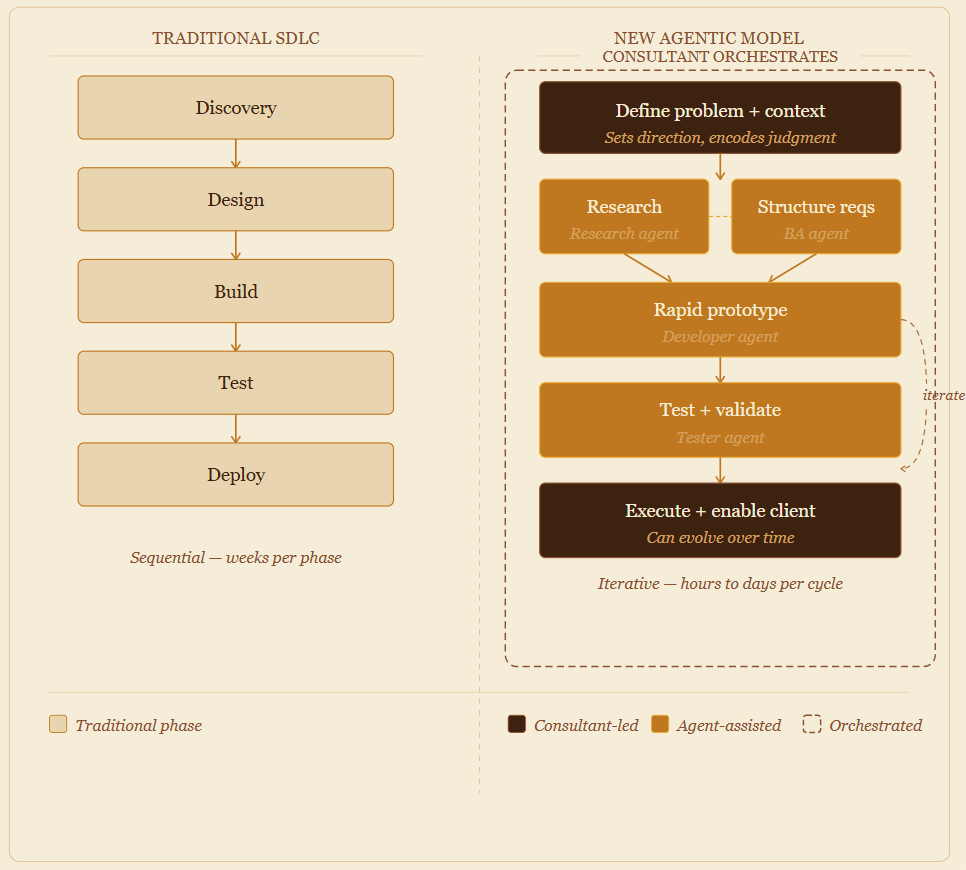
Most technology consulting projects still follow some version of the software development lifecycle (SDLC).
Discovery
Design
Build
Test
Deploy
The early phases focus heavily on gathering information and producing documentation. Teams run workshops, capture requirements, design systems, and document processes before anything is built. This structure made sense when building systems was slow and expensive. The safest approach was to spend significant time planning before development began.
When I first started consulting, AI wasn’t really part of this lifecycle at all.
Then the conversation started to change.
Teams began asking how AI tools could help within each step of the delivery process. AI could summarize discovery sessions. It could help draft requirements documents. It could generate early code snippets or assist with test scripts. The lifecycle itself stayed mostly the same. We were just inserting AI tools into each step.
More recently, the question has shifted again.
Instead of asking how AI fits into the delivery lifecycle, teams are starting to ask something different: What if the lifecycle itself changes?
Why the Traditional SDLC is Starting to Change
The biggest impact of AI isn’t just intelligence. It’s speed.
Teams can now generate research, documentation, and early development artifacts incredibly quickly. Industry analysis, solution ideas, and system components that once required weeks of work can now be produced in hours.
When information and early system artifacts become cheap to produce, the economics of project delivery change.
Instead of trying to perfect a design on paper, it becomes much more efficient to test ideas directly in working systems. Teams can form a hypothesis, build a prototype, test it with stakeholders, and iterate quickly.
This creates a different style of delivery.
Two things define it.
- Rapid prototyping and iteration.
- Agent-assisted development.
- Rapid Prototyping Becomes the Accelerator of Delivery
In traditional consulting engagements, documentation often served as the primary tool for designing future systems. Requirements documents, process diagrams, and solution designs described how a system should work before it was ever built.
AI makes it easier to move directly into working prototypes. Instead of relying entirely on documentation, teams can build thin slices of real workflows early in a project.
A prototype might represent a sales pipeline, a case management workflow, or a customer onboarding process. Stakeholders can interact with it and test real scenarios. This allows teams to validate assumptions much earlier. If something doesn’t work, the team can adjust quickly and build another version.
The philosophy behind this approach is not new. Iterative development has existed for years. What AI changes is the speed – prototypes that once required weeks of effort can now be produced in hours or days. That dramatically lowers the cost of experimentation, which means rapid iteration becomes the most effective way to design systems.
2. Delivery Will Increasingly Become Agentic
At the same time, development tools themselves are evolving. Early AI tools mostly helped with individual tasks like writing text or completing code. Newer tools are beginning to behave more like agents that can execute larger workflows.
These systems can read entire research reports or codebases, modify multiple files, run tests, generate pull requests, and document their changes. Tools like Cursor and Claude Code are early examples, but the space is evolving quickly, and the tools are only getting better.
Instead of doing every task manually, consultants can begin orchestrating these agents to perform parts of their workflow.
For example:
The Research Agent (built using Claude) might take 15 minutes to scan industry data and synthesize research across hundreds of sources. Then, The Business Analyst Agent (built using ChatGPT) might take that output and structure a set of requirements or a draft strategy tailored to a specific client. The Developer Agent (built using Cursor) can then take those requirements and generate a working prototype. Then, The Tester Agent comes along to generate test cases and validate outputs.
Over time this creates a different style of work. Consultants are not just producing analysis or writing code. They are designing systems of agents that help execute the work. Those agents can be trained on industry context, internal methodologies, and past project experience. But they still require direction, structure, and judgment.
The consultant becomes the orchestrator. They define the problem, design the system, guide the agents, and execute with precision.
The Shift is Underway
It is important to be realistic about where the industry stands. This transformation is not happening all at once.
In my own work, I’ve built multiple agents trained on specific industries and process redesign. I’ve seen developers doing the same for their own workflows. Now, it’s about putting the puzzle pieces together to move towards more connected, agentic orchestration.
But even in this early stage, there is a clear shift in the way work is getting done.
Consultants who want to keep up must integrate AI into their everyday workflows. The shift from no AI, to using AI within each step, to rethinking the entire delivery model is already underway.
Sources
(1) Peng et al. (2023), The Impact of AI on Developer Productivity
https://arxiv.org/abs/2302.06590
(2) Brynjolfsson et al. (2023), Generative AI at Work https://www.hbs.edu/faculty/Pages/item.aspx?num=64700


